Finding inner peace isn’t some far-off, mystical goal reserved for monks on a mountaintop. It’s a practical, real-world skill you build through small, intentional actions every single day. True calm comes from getting to know your inner world and actively shaping how you respond to the outer one.
It’s a journey you can start right now.
Your Practical Path to Inner Peace Starts Here
Does the desire for a calm, centered mind ever feel completely at odds with your daily life? I get it. The constant ping of notifications, relentless work pressures, and a never-ending social calendar create a low-grade hum of stress that feels impossible to turn off.
But here’s the thing: finding inner peace isn't about escaping the world. It’s about learning to navigate it with more resilience and clarity. It's about building a stable inner foundation that holds steady, even when life outside gets turbulent.
This guide skips the vague, fluffy advice. Instead, we’re going to walk through a concrete framework for building that stability. It's an approach built on four core pillars, giving you an accessible roadmap to quiet the noise, manage stress, and find clarity no matter how hectic your life feels.
To get a quick overview of where we're headed, this table breaks down the four pillars that form the foundation of our approach.
The Four Pillars of Inner Peace
| Pillar | Core Focus | Key Actionable Steps |
|---|---|---|
| Pillar 1: Mindful Awareness | Paying attention to the present moment without judgment. | Practicing daily mindfulness, body scan meditations, mindful breathing. |
| Pillar 2: Conscious Living | Aligning your daily actions with your core values. | Defining personal values, setting intentional boundaries, simplifying your environment. |
| Pillar 3: Emotional Resilience | Developing the capacity to navigate and recover from challenges. | Practicing self-compassion, reframing negative thoughts, building a support system. |
| Pillar 4: Purposeful Connection | Cultivating meaningful relationships and a sense of belonging. | Nurturing connections, practicing gratitude, contributing to something larger than yourself. |
Each pillar supports the others, creating a holistic structure for a more grounded and peaceful life.
This next infographic gives you a great visual summary of how these concepts all tie together. Think of it as our map for the journey ahead.
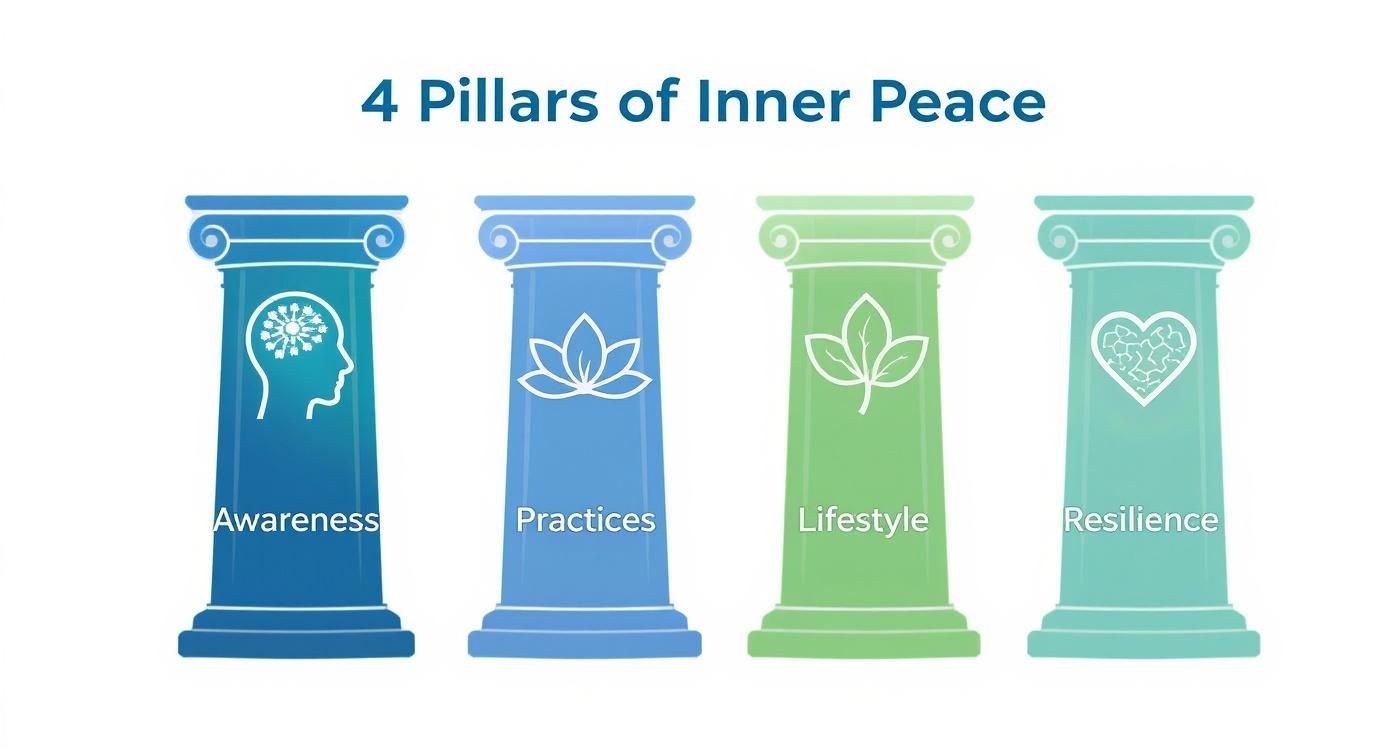
As you can see, this is a balanced approach. We're not just trying to put a band-aid on stress; we're building a sustainable foundation for lasting calm by working on awareness, practices, lifestyle, and resilience all at once.
This entire journey really starts with getting clear on what matters most to you. Before diving into specific techniques, it helps to define what a peaceful and meaningful life actually looks like on your own terms. If you need a hand with that, our guide on how to create a personal mission statement offers a fantastic, structured way to pin down your core values and direction.
Inner peace isn't something you wish for. It's something you make, something you do, and something you are. It’s an active process of choosing presence over distraction and compassion over criticism.
The strategies we'll cover are designed to be practical and easy to adapt. You don't need to block out hours for meditation or make drastic life changes overnight. It’s all about integrating small, powerful habits into your existing routine, empowering you to build a more serene and centered life, one step at a time.
Ready? Let's start by exploring that first pillar.
Map Your Inner World with Mindful Awareness
Before you can find your way to inner peace, you have to know where you’re starting from. Think of it like this: you can't get directions to a new city without first knowing your current location. This means getting intimately familiar with the terrain of your own mind—the thoughts that play on a loop, the emotional triggers, and the deep-seated beliefs that quietly run the show.
Finding inner peace isn’t about immediately fixing anything. It starts with self-observation, approached not with judgment, but with a gentle, open curiosity.
This isn't a call to criticize yourself for feeling anxious or frustrated. It’s about becoming a neutral witness to your own internal weather. When you can see your thoughts and feelings as passing events instead of absolute truths about who you are, you create just enough space to choose a calmer response. This shift—from being caught in the storm to simply watching the storm—is the heart of mindful awareness.
Mindful Journaling to Uncover Your Patterns
One of the most powerful ways to map your inner world is through mindful journaling. This goes way beyond just listing what you did today. It's an invitation to explore the why behind your reactions and feelings, helping you decode the stories your mind is constantly spinning.
Forget generic prompts like, "How was your day?" We need to go deeper to uncover the patterns hiding in plain sight.
Try these instead:
- "What story did my anxiety tell me today?" This helps you separate the raw feeling from the narrative it creates. You start to see that thoughts are just thoughts, not facts.
- "When did I feel most at peace, and what was I doing?" This helps you identify your personal peace triggers. Was it listening to a specific playlist? Walking the dog? Once you know what they are, you can intentionally schedule them.
- "What emotion did I try to avoid today, and what was I afraid would happen if I just let myself feel it?" This gets to the heart of emotional resistance, which often causes more suffering than the emotion itself.
For example, through journaling, you might notice that your anxiety consistently spins a story about not being prepared enough for work meetings. Once you see it as a recurring narrative—not a reality—you can deal with it directly. Actionable Insight: Create a simple two-item checklist for meeting prep. Before each meeting, you can glance at it and confirm you've done your prep, calmly telling the anxious story, "Thanks for the concern, but I've got this covered." This is a world away from just noting, "Felt anxious before my 10 a.m. meeting."
By consistently observing these internal narratives, you begin to understand your unique emotional landscape. This awareness is the foundation upon which you can build lasting serenity and a deeper understanding of what gives life meaning for you personally.
Processing Emotions in Real-Time with RAIN
Journaling is fantastic for reflection, but what about when a difficult emotion hits you in the middle of the day? For that, you need a tool you can use on the spot.
The RAIN technique is a game-changer for processing feelings without letting them hijack your day. It’s a simple, structured practice that guides you through moments of emotional overwhelm.
RAIN is an acronym that stands for:
- Recognize what is happening.
- Allow the experience to be there, just as it is.
- Investigate with kindness and curiosity.
- Nurture with self-compassion.
Let’s walk through a real-world scenario. Imagine you receive a blunt, critical email from your boss. Your immediate reaction is a hot flush of anger and shame. Instead of firing back a defensive reply, you can apply RAIN.
First, you Recognize what's happening. "Okay, I'm feeling anger and shame. My chest is tight, my face is hot, and my mind is racing." You're just naming the internal experience.
Next, you Allow it to be there. This is the hardest part. You don't try to shove it down or lecture yourself for being "too sensitive." You just let the feelings exist, giving them space without needing to act on them.
Then, you Investigate with a gentle curiosity. Ask yourself, "What is this feeling really about? What am I believing in this moment?" You might discover the anger is a shield for the shame, which is connected to a deeper fear of not being good enough at your job.
Finally, you Nurture yourself with self-compassion. Place a hand over your heart and silently say something kind: "This is a painful feeling. It's okay to be upset by criticism." This small act soothes your nervous system and gives you the clarity to draft a calm, professional response later, rather than reacting from a place of hurt.
Build Daily Habits for a Calmer Mind
Inner peace isn't something you find after a week-long silent retreat. The real secret is that it's built, piece by piece, in the small, quiet moments of your everyday life.
It's about cultivating a toolkit of simple, practical habits you can weave into your existing routine. You don't need to add more to your plate. Instead, you infuse what you're already doing with more presence. These small acts are like planting seeds; they don't look like much at first, but with consistency, they grow into a mind that is resilient, grounded, and genuinely calm.
Reset Your Nervous System with Box Breathing
When stress spikes in the middle of a hectic workday, you need a quick, discreet way to get back to center. This is where box breathing comes in. It’s a powerful technique, used by everyone from Navy SEALs to surgeons, to calm the nervous system in just a minute or two.
Here's the simple four-step pattern:
- Inhale slowly through your nose for a count of four.
- Hold your breath gently for a count of four.
- Exhale slowly through your mouth for a count of four.
- Hold at the bottom of the exhale for a final count of four.
Actionable Insight: The next time your phone rings with a number you don't recognize or a notification pops up about a stressful email, don't answer immediately. Perform one cycle of box breathing before you engage. This creates a tiny buffer between the stimulus and your response, allowing you to react with a clearer head instead of pure reflex. That simple act can shift you from a state of fight-or-flight to one of focused calm.
Create Mindful Moments in Your Daily Routine
Mindfulness doesn't have to mean sitting on a cushion for an hour. You can practice it anywhere by turning mundane activities into moments of focused presence. The goal is to anchor your attention to a single sensory experience, pulling your mind out of its usual chaotic loop.
Your morning coffee is a perfect opportunity. Instead of scrolling through your phone, turn it into a two-minute mindful moment:
- Feel the warmth of the mug in your hands.
- Watch the steam rising.
- Inhale the aroma before you take the first sip.
- Focus completely on the taste. When your mind wanders to your to-do list (and it will), gently guide it back to the sensation of the coffee.
Another practical example: Use the walk from your car to your office door as a mindfulness exercise. Instead of thinking about the first task of the day, focus on the sensation of your feet on the pavement, the feeling of the air on your skin, and the sounds around you. You're proving to yourself that calm is accessible in the simplest parts of your day.
The secret to a more peaceful mind isn’t finding more time for elaborate routines. It’s about infusing the time you already have with more intention and presence.
This isn't just a niche practice anymore. As people seek real ways to manage modern stress, these habits are going mainstream. In fact, over 275 million people worldwide now engage in meditation practices. For 92% of them, the primary driver is stress relief. The data backs this up, with studies showing consistent practice can slash anxiety by up to 60% within a year. This global shift toward prioritizing mental well-being is undeniable. You can discover more insights about these meditation trends and their impact.
Release Physical Tension with a Body Scan
Ever notice how stress physically lives in your body? It shows up as a clenched jaw, tight shoulders, or a knot in your stomach. A 10-minute guided body scan is one of the most effective ways to consciously release that accumulated tension and set yourself up for truly restful sleep.
Here's a simple, actionable way to do it tonight:
- Lie comfortably in bed.
- Start with your feet. Squeeze every muscle in both feet as tight as you can for five seconds, then release completely. Notice the difference between tension and relaxation.
- Move up to your calves. Tense them for five seconds, then release.
- Continue this process, tensing and releasing major muscle groups: thighs, glutes, abdomen, hands (into fists), arms, shoulders (up to your ears), and finally, your face (scrunching it up).
- After the final release, lie still for a minute and enjoy the feeling of profound physical relaxation.
This exercise does more than just relax your muscles; it strengthens the mind-body connection. Over time, you'll become more aware of how stress shows up physically, empowering you to address it before it takes hold.
Design an Environment That Nurtures Peace
We often think of inner peace as a purely internal job. While that's a huge piece of the puzzle, the world outside your mind plays a massive role, too. A chaotic, overstimulating environment is constantly pulling at your attention and triggering your stress response.
The good news? You can consciously design your physical and digital spaces to create a sanctuary that actively supports your journey. This isn't about achieving a picture-perfect minimalist home. It's about making small, intentional choices that reduce mental friction and create more room for stillness.

Set Firm Digital Boundaries
Our phones are a primary source of modern anxiety. That constant stream of notifications keeps our brains in a state of perpetual reactivity. Setting clear boundaries is about reclaiming control over your attention.
Actionable Insight: Tonight, create a "charging station" for all family devices that is explicitly outside of the bedrooms. This single change removes the temptation for late-night scrolling and protects your sleep.
Another powerful tactic is the weekly digital sunset. Pick one night a week—say, Wednesday—where all screens are turned off by 8 p.m. Use that time to read a physical book, listen to music, or talk with your family. This simple ritual sends a powerful signal to your brain that it's time to wind down.
Practice Intentional Consumption
What you let into your mind through your screens directly impacts your mood. Mindlessly scrolling through a feed packed with bad news and social comparison is like feeding your brain a steady diet of junk food. Intentional consumption is about becoming the conscious curator of your own mental diet.
Here's a simple audit you can do in 15 minutes:
- Social Media: Go through your "following" list. Actionable Step: Unfollow five accounts right now that consistently make you feel anxious, angry, or less-than. Replace them with five accounts that post calming nature scenes, inspiring art, or funny animal videos.
- News Intake: Instead of getting reactive updates pinged to you all day, schedule a specific time to check the news. For example, read a news summary for 15 minutes while you have your morning coffee, and that's it for the day.
- Notice the Effect: Pay attention to how you feel after consuming certain content. Does that political podcast leave you feeling empowered or just enraged? Adjust your media diet based on this self-awareness.
The goal isn’t to become uninformed. It’s to shift from being a passive recipient of whatever the algorithm serves you to an active gatekeeper of your own mental well-being.
Declutter Your Physical Space
The link between a cluttered home and a cluttered mind is very real. A messy space can subtly increase cortisol, our primary stress hormone. You don't need a massive weekend overhaul; small, targeted actions can make a world of difference.
Actionable Insight: Choose one "hotspot"—the kitchen counter, your nightstand, the chair in your bedroom that collects clothes. Set a timer for 10 minutes. In that time, clear only that one spot. Put things away, throw out trash, and wipe it down. That single, clear surface creates a small pocket of visual calm, and the feeling of accomplishment can motivate you to tackle another spot tomorrow.
Bring Nature Indoors
Spending time in nature is one of the most reliable ways to reduce stress. But you can bring the calming effects of the natural world right into your home.
Practical Examples:
- Add a low-maintenance snake plant or pothos to your workspace. They are nearly impossible to kill and help purify the air.
- Make it a habit to open your windows for 10 minutes every morning to let in fresh air and natural light while you get ready.
- Change your computer's desktop background to a high-resolution photo of a forest or a beach. It’s a small, constant visual cue for tranquility.
These small touches act as gentle reminders to breathe and connect with the world beyond your to-do list.
Navigate Difficult Emotions with Compassion
Finding inner peace doesn't mean you'll suddenly stop feeling sad, angry, or anxious. A truly peaceful life isn’t about eliminating these emotions. It's about learning how to hold them with grace and understanding when they show up.
Resilience isn't built by avoiding storms, but by learning how to navigate them without letting them capsize your boat. This requires a profound shift: instead of treating difficult feelings as enemies to be conquered, we can learn to see them as messengers, trying to tell us something important.
Embrace Reality with Radical Acceptance
One of the most powerful tools for weathering emotional storms is radical acceptance. It’s acknowledging reality exactly as it is, without fighting it. This doesn't mean you have to like the situation. It means you stop wasting energy wishing it were different.
Practical Example: You get stuck in a massive traffic jam and will be late for an important appointment. The typical reaction is frustration and panic. Radical acceptance looks like this: take a deep breath and say out loud, "I am in a traffic jam. I will be late. I cannot change this fact right now." This simple acknowledgment stops the mental spiral. Actionable Insight: Your energy can now shift to what you can control. You can make a quick, safe call to let the person know you're running late. You can put on a calming podcast. You've accepted the reality and are now responding effectively instead of reacting emotionally.
Radical acceptance is about letting go of the illusion of control and accepting what is. It's the first step toward responding to life's challenges with clarity and calm.
Offer Yourself Kindness with a Self-Compassion Break
When you’re struggling, is your inner critic the loudest voice in the room? Self-compassion is the antidote. It’s treating yourself with the same kindness you’d offer a good friend. A "self-compassion break" is a fantastic, in-the-moment exercise for this.
It involves three simple steps you can do anywhere, anytime you feel overwhelmed:
- Acknowledge the Pain: Mindfully notice your suffering. Say to yourself, "This is really hard right now." This validates your experience.
- Recognize Common Humanity: Remind yourself that suffering is part of being human. A simple phrase like, "Everyone feels overwhelmed sometimes," helps you feel less isolated.
- Offer Yourself Kindness: Gently place a hand over your heart and offer yourself words of comfort. Say, "May I be kind to myself in this moment," or "May I give myself the compassion I need."
Actionable Insight: The next time you feel overwhelmed by your to-do list, take 60 seconds for this break. Literally stop, put a hand on your chest, and walk through these three steps. It interrupts the harsh cycle of self-criticism and activates your body's natural soothing systems.
Cultivate Gratitude by Savoring Small Moments
Building a lasting gratitude practice is more than just listing things you're thankful for. It's about learning to savor the small, positive moments already scattered throughout your day. This actively trains your brain to notice the good that is already present.
Here are concrete ways to practice savoring:
- That First Sip of Coffee: Don't just gulp it down. For the first sip, close your eyes and focus only on its warmth, aroma, and taste. Fully immerse yourself in that simple pleasure.
- A Moment of Connection: When a friend sends a funny text, don't just rush past it. Linger in that feeling of connection for an extra three seconds. Let yourself smile.
- The Comfort of Home: As you unlock your door at the end of the day, take one conscious breath and truly feel the sense of safety and comfort your home provides.
This move toward structured, internal practices for well-being is happening on a global scale. The global meditation market was valued at around USD 7.51 billion and is projected to more than double to USD 17.78 billion. This shows a massive shift toward people seeking effective ways to manage their mental and emotional health. You can read the full research about this market growth.
By weaving radical acceptance, self-compassion, and savoring into your emotional toolkit, you build the resilience needed to face life's challenges with a more centered heart.
Sustain Your Practice for Lasting Serenity
Finding inner peace isn’t like crossing a finish line. It’s a practice, something you weave into the messy, beautiful rhythm of your actual life.
The real work begins when you take these tools off the meditation cushion and into your day-to-day. You’re going to have days where your practice feels effortless and others where you forget it entirely. That’s normal. The goal here is gentle consistency, not rigid perfection.
When you miss a day of journaling, the impulse might be to criticize yourself. Resist it. The real practice is simply to notice, offer yourself a little kindness, and begin again tomorrow. This small shift is what turns these actions from a chore into a deep, lasting source of resilience.
Create Your Personalized Peace Plan
For any of this to stick, it has to work for you. A sustainable practice is an adaptable one. Think of your "peace plan" less like a strict set of rules and more like a flexible menu of options you can choose from.
Actionable Insight: Create a "peace menu" on a sticky note and put it on your monitor or fridge. List 3-5 simple options: "5 deep breaths," "Listen to one calm song," "Walk around the block," "5-minute journal." On a crazy day, you can just glance at the menu and pick one. On a quiet Sunday, it might be a long walk in nature. The number of people meditating globally has climbed from 29% to around 35%, with 40% of young adults driving this shift. You can find more details about the global rise in meditation on winmr.com.
Remember, the most effective tool for finding inner peace is the one you actually use. Choose practices that genuinely resonate with you and fit into your life as it is today.
Finding a community—or even just one trusted friend—can make all the difference, reminding you that you aren't walking this path alone. Anchoring these daily efforts to a deeper sense of why you're doing them can also be incredibly powerful. If you're looking for more clarity on what truly drives you, our Find Your Life Purpose Quiz is a great place to start exploring.
Got Questions About Finding Inner Peace?
As you start exploring this path, you’re bound to have questions pop up. That’s completely normal. The journey to inner peace isn't a straight line, and almost everyone bumps into the same few hurdles along the way. Let's get into some of the most common ones we hear.
How Long Does It Take to Actually Feel a Difference?
This is the big one, isn't it? And the honest answer is, you'll probably feel small shifts pretty quickly, but the deep, lasting change is a slower, more gradual process. Finding inner peace is an ongoing practice, not a race with a finish line.
Many people tell me they feel a real sense of calm within a few weeks of sticking to a simple daily practice, like a 10-minute meditation or a quick journaling session. It might show up in small ways first—maybe you don't get as worked up in traffic, or you find a bit more patience with that one coworker. Those are the first signs it's working.
The real secret is consistency, not intensity. A deeper, more stable sense of peace often builds over months of gentle, repeated effort. Just focus on showing up for your practice today, and trust that the benefits are quietly stacking up over time.
Can I Find Peace Without Meditating?
Absolutely. While meditation is a fantastic tool, it's definitely not the only path. Anything that helps you quiet the relentless mental chatter and just be here, in the present moment, is a doorway to peace.
Think about it: what activities completely absorb your attention and make you feel connected to the ground beneath your feet? It could be anything, really.
- Spending some quiet time in nature, even just a slow walk through a local park.
- Getting lost in a creative hobby like painting, writing, or strumming a guitar.
- Moving your body with intention through practices like yoga or tai chi.
The whole point is to find what resonates with you. The journaling prompts, boundary-setting exercises, and gratitude practices we talk about in this guide are all powerful ways to build inner peace, completely separate from any formal meditation.
What If My Mind Is Too Busy to Get Calm?
Welcome to the club! A busy, wandering mind isn't a bug; it's a feature of being human. In fact, feeling like your mind is "too busy" is the whole reason these practices are so powerful.
The goal isn't to wrestle your thoughts into submission or force them to stop—that’s impossible and will only create more stress. Instead, you're learning to change your relationship with your thoughts.
You’re training yourself to be the observer, watching your thoughts float by like clouds in the sky without getting carried away by them. Start small. Try a guided practice for just three to five minutes, focusing only on the physical sensation of your breath. When your mind inevitably wanders off (and it will), just gently, without any judgment, guide your attention back.
Every single time you do that, you're doing a rep for your "mindfulness muscle." The real magic is in the patient, kind act of returning, not in achieving some mythical state of a perfectly empty mind.
At How To Find Your Life Purpose, we believe that a deep sense of peace comes from living a life that truly feels like your own. Our tools and resources are all designed to help you get that kind of clarity. Ready to explore your unique path? Come visit us at https://findyourlifepurpose.org.