If you're trying to find your purpose in life, the most powerful thing you can do is stop asking, "What should I do?" and start exploring, "Who do I want to be?"
This simple flip reframes the entire quest. Purpose stops being some elusive destination you have to find out there—a perfect job or a grand calling—and becomes a quality you build from within. It’s something you can bring to every single moment, no matter your current job or life situation.
Starting Your Journey to a Purposeful Life
Feeling adrift? It’s a feeling most of us know well. But finding your purpose isn't some mystical quest for a single, lightning-bolt revelation. It's a practical, hands-on journey of getting to know yourself. Forget the abstract philosophy; this guide is all about actionable exercises and a clear framework to uncover what truly makes you tick.
Think of it this way: you’re shifting from searching for an external achievement (like a fancy job title) to building an internal compass. This inner guide is what helps you navigate all of life's decisions, big and small, making sure they actually feel like you.
When you lead from this place of purpose, you don't have to wait for your actions to give you meaning. You infuse meaning into your actions.
Building Your Foundation for a Meaningful Life
The first step is always building a solid foundation, and that foundation is self-awareness. It’s about getting brutally honest about who you are when you’re at your best and then actively looking for ways to be that person more often. This is where a truly authentic life begins.
Living this way has some incredible side effects:
- Greater Resilience: A strong sense of 'why' makes you surprisingly steady when life gets rocky. For example, a project failure at work feels less like a personal catastrophe and more like a data point when your purpose is "to solve complex problems through creative collaboration."
- Increased Motivation: When your daily grind connects to something bigger, your drive becomes deeper and far more sustainable than just chasing a paycheck. Imagine a nurse whose purpose is "to provide compassionate care." On a tough day, that purpose provides a deeper well of energy than just thinking about the salary.
- Improved Well-being: There's a reason people who align their lives with their values report higher levels of happiness and satisfaction. It just feels right.
This visual shows how the process flows, moving from that inner work to real-world alignment.
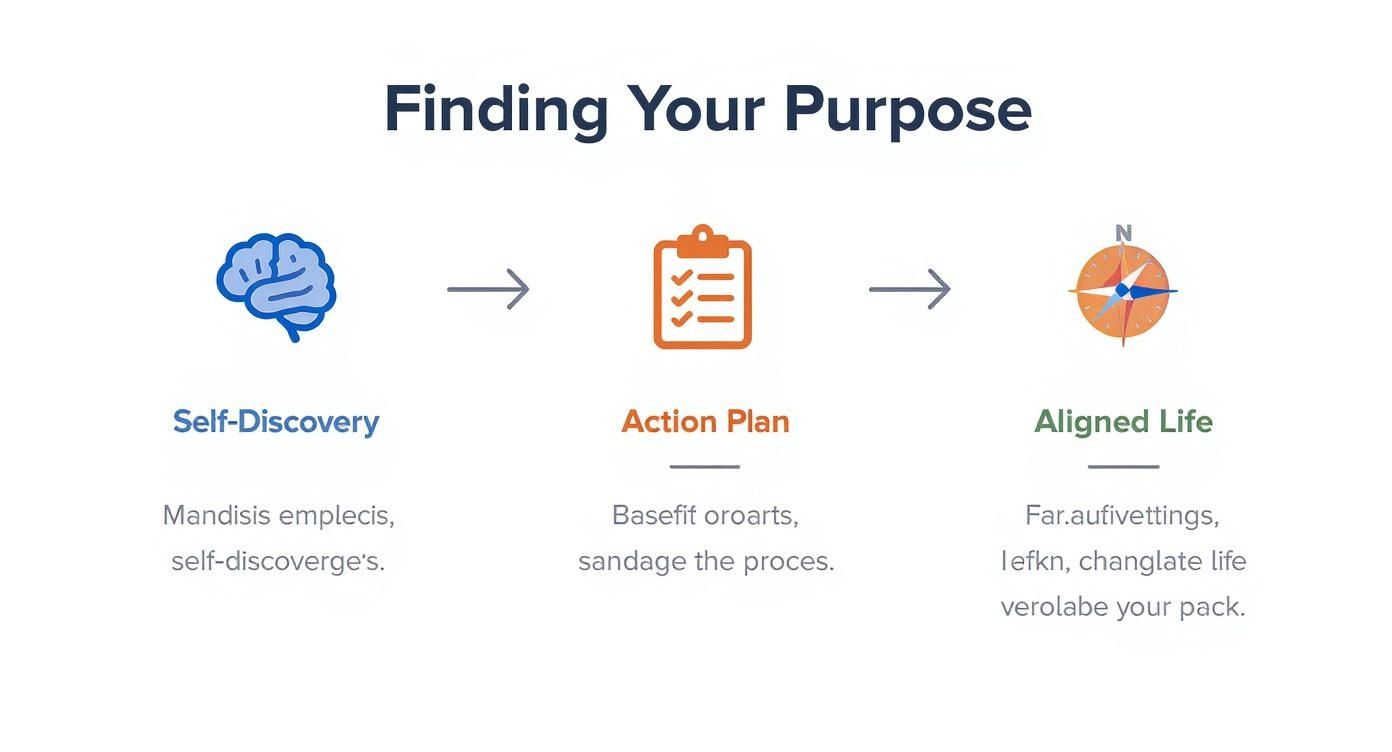
As you can see, it all starts with that deep dive into self-discovery. That insight then shapes a clear plan of action, which ultimately helps you build a life that’s in sync with your core values.
The most powerful shift you can make is to stop searching for a purpose to find, and start creating a purpose to live. You don't discover your purpose; you build it through conscious choices every single day.
Let’s make this real. Imagine a marketing manager who feels completely unfulfilled by her job. If she keeps asking "What should I do?" she'll just keep looking for other job titles.
But if she asks, "Who do I want to be?" she might realize her purpose is to "empower creative people." Suddenly, her entire perspective shifts. She can start living that purpose right now in her current role—by mentoring junior designers, fighting for innovative projects, and championing her team's wins.
She finds meaning exactly where she is. This internal shift puts you back in the driver's seat, letting you live with purpose today while you shape the future you want. Now, let’s get to work.
Understanding the Core Elements of Purpose
Before you can find your purpose, it helps to know what you’re actually looking for. The idea can feel massive and abstract, but it really boils down to the intersection of a few key ingredients. When these elements click into place, life feels energized and meaningful. When they don't, you're left with that nagging feeling that something is missing.

If you've felt that way, you're far from alone. A 2021 global survey by Ipsos found that while 71% of people across 30 countries described themselves as happy, that number has actually been on a slow decline since 2011.
What’s really interesting is what people said made them happy. Family, relationships, and feeling loved topped the list, blowing factors like wealth or status out of the water. This points to a universal truth: we're wired for connection and a sense of belonging. These are essential pieces of the purpose puzzle.
So, how do we translate this into a framework you can actually use? The best way I've found to think about purpose is through four core pillars that hold everything up.
The Four Pillars of Personal Purpose
Think of these pillars as the four legs of a table. If one is too short or missing entirely, the whole thing gets wobbly and unstable. True, lasting fulfillment comes from the place where these four areas overlap, creating a solid foundation for your life.
Let's break them down with practical questions to get you started.
Here’s a simple table to help you visualize these pillars and start reflecting on your own life.
| Pillar | What It Means | Key Question to Ask Yourself | Actionable Insight |
|---|---|---|---|
| Passion (What you love) | These are the topics, activities, and ideas that genuinely light you up and energize you, with or without a reward. | What topics could I talk about for hours without getting bored? | List 3 things you loved doing as a child. What do they have in common? |
| Values (What you believe in) | These are your non-negotiable principles—the personal code of conduct that guides your decisions and actions. | What qualities do I admire most in other people? | Think of a decision you're proud of. What value was driving it? |
| Skills (What you're good at) | This covers both your natural talents and the abilities you've honed through practice and experience. | What do people consistently ask me for help with? | Ask 3 trusted friends or colleagues what they see as your greatest strength. |
| Impact (How you contribute) | This is your desire to connect your actions to something bigger than yourself, whether it's helping others or solving a problem. | What problems in the world do I wish I could solve? | If you had a magic wand to fix one problem in your community, what would it be? |
Seeing these four pillars laid out like this helps you start to diagnose where things might be out of sync. It gives you a map to understand the different forces at play.
Real-World Examples of Purpose in Action
Let’s make this less abstract. Purpose isn’t always about quitting your job to save the rainforest (though it can be!). More often, it shows up in subtler, but just as powerful, ways.
Take a software engineer who’s good at her job but feels like she’s just going through the motions. Her passion is creative problem-solving, her skill is coding, and a core value is community support. She finds a deeper sense of impact by volunteering a few hours each week to build a website for a local animal shelter. She didn't have to change her whole life—she just found a way to align her skills with her values to create meaning.
Or think about a stay-at-home parent. Their passion might be nurturing growth, their values center on family and compassion, and their skills include incredible patience and organization. The impact is profound: raising thoughtful, resilient, and kind human beings. It's a powerful expression of purpose that our society often overlooks.
Purpose isn’t a destination you arrive at; it's the lens through which you see and shape your life. It’s about finding the intersection of what you love, what you're good at, what the world needs, and what you deeply believe in.
By understanding these components, you can start to see where your own life might be out of alignment. If you're skilled at a job you have no passion for, you'll feel bored. If you're passionate about a cause but feel you lack the skills to contribute, you'll end up frustrated.
Getting a clear picture of these elements is the first step toward consciously building a more meaningful life. To go deeper on the psychology behind this, check out our article on what gives life meaning.
Alright, let's get our hands dirty. Knowing the theory behind purpose is one thing, but actually finding it? That's where the real work—and the real fun—begins.
This isn't about some mystical quest to find a single, perfect answer overnight. It’s more like an excavation. We’re going to dig into who you are and what makes you tick, moving from fuzzy ideas to tangible truths. These aren't just thought experiments; they're practical tools for your journey.
Find Your Sweet Spot with Ikigai
One of the most powerful frameworks I've come across is the Japanese concept of Ikigai (pronounced ee-kee-guy). It’s often translated as "a reason for being," but I think of it as finding your personal sweet spot—that sustainable, fulfilling intersection where the most important parts of your life meet.
Imagine drawing a Venn diagram with four overlapping circles. Your Ikigai is right in the middle where they all connect:
- What You Love: Your passions. (e.g., "I love hiking and being in nature.")
- What You're Good At: Your skills. (e.g., "I'm great at planning and logistics.")
- What the World Needs: Your contribution. (e.g., "People need safe, accessible ways to enjoy the outdoors.")
- What You Can Be Paid For: Your profession. (e.g., "Leading guided nature tours for families.")
Grab a notebook and actually draw the four circles. Start jotting things down in each one. Don't edit yourself—just let the ideas flow. Maybe you realize your skill for organizing events (what you're good at) and your love for connecting people (what you love) could fill a need for local networking events (what the world needs), which could eventually become a business (what you can be paid for).
Ikigai isn’t about finding the one perfect job. It’s a holistic map that helps you see how your passions, skills, and values can align to create a more integrated and meaningful life, both in and out of work.
This simple diagram is a fantastic diagnostic tool. If you’re doing what you love and what you’re good at but not getting paid, you’ve got a hobby, not a career. If you’re getting paid for something you’re good at but don’t love, you're on the fast track to burnout. The goal is to nudge your life closer to that vibrant center.
Pinpoint Your Core Values
If Ikigai is the map, your core values are your compass. They're the non-negotiable principles guiding your choices, especially when things get tough. Living a life that clashes with your values creates a constant, low-grade friction you might not even be able to name.
Let's get yours down on paper with a concrete exercise.
- Brainstorm: Set a timer for 10 minutes. List as many values as you can. Think about concepts like Freedom, Security, Creativity, Compassion, Integrity, Growth, or Community. Don't hold back—aim for a list of at least 15-20 words.
- Group and Define: Now, look for themes. Maybe "adventure," "novelty," and "learning" all fit under a bigger value you call "Exploration." Crucially, define what each value means to you. "Freedom" for one person means financial independence; for another, it means a flexible schedule.
- Prioritize: This is the toughest part. Imagine you could only keep five of these values to live your life by. Which ones would they be? Force-rank your list until you have your top five. These are the pillars of your life.
With your top five values identified, start running your life decisions through them like a filter. If "Autonomy" is one of your core values, that micromanaged job is always going to feel like a cage. If "Connection" is at the top of your list, a remote job in total isolation will leave you feeling empty, no matter the salary. Seeing how others have built their lives around their core principles in these real-world life purpose examples can make this process click.
Use a Journal to Hunt for "Flow"
Your own past is a goldmine of data. The clues to your purpose are often hidden in the moments you felt most engaged and alive—that state psychologists call "flow," where you completely lose track of time.
Use these journaling prompts to start digging for those golden moments. Commit to answering one prompt each evening for a week.
- Describe a time you were so absorbed in something that hours felt like minutes. What were you doing? Was anyone else there?
- Think about a challenge you tackled that left you feeling incredibly proud. What specific skills did you use to pull it off?
- When have you felt most helpful or of service to other people? Paint a picture of the situation and how it made you feel.
Don't just give one-sentence answers. Dive deep. Write about the emotions, the setting, the specific actions you were taking. After a week or so, read back through your entries with a highlighter. Look for patterns. You’ll start to see a thread connecting the moments you felt most authentically you, and that thread is pointing straight toward your purpose.
Navigating Roadblocks on Your Path to Purpose
Let's be honest: the journey to find your life's purpose is rarely a straight line. It’s more like a winding mountain trail, complete with unexpected detours, steep climbs, and patches of thick fog where you can barely see your own feet.
These roadblocks aren’t a sign that you’re doing something wrong. Quite the opposite. They're a normal, even necessary, part of the process—proof that you're engaging in work that actually matters.
Whether it’s the quiet pressure from family or the loud, internal fear of making the "wrong" choice, these hurdles are universal. The first step to getting past them is simply to see them for what they are: common challenges, not personal failings.
Common Hurdles and How to Get Over Them
Let's tackle some of the most common obstacles head-on with actionable strategies.
-
The Fear of Change: Our brains are wired for safety and predictability. The idea of stepping off your current path—even a deeply unfulfilling one—can trigger some serious anxiety. It’s the comfort of the known versus the terror of the unknown.
- Actionable Insight: Start with micro-experiments. Instead of impulsively quitting your job to become a potter, just sign up for a weekend pottery class. Want to be a writer? Commit to writing for 15 minutes every morning for two weeks. These small, low-risk actions build confidence and give you real-world data without demanding a life-altering leap of faith.
-
Societal and Family Expectations: You might feel a ton of pressure to follow a path that others have defined as "successful"—a certain career, a specific salary, a predictable life. The weight of these "shoulds" can be crushing.
- Actionable Insight: Gently separate the "shoulds" from the "wants." Grab a piece of paper and create two columns. In one, list everything you feel you should do (e.g., "I should get a promotion," "I should buy a bigger house"). In the other, list what you genuinely want to do (e.g., "I want a job with more flexibility," "I want to spend more time outdoors"). Just seeing the conflict written down is the first step to choosing your own path.
The greatest roadblock to a purposeful life is often the belief that we have to please everyone else first. Your purpose is your own; it doesn't require a committee's approval.
- Analysis Paralysis: With what feels like infinite options, it’s easy to get stuck researching and planning, never actually taking that first step. You're terrified of choosing the "wrong" purpose.
- Actionable Insight: Embrace the "good enough for now" principle. Your purpose isn't a permanent tattoo; it's more like a compass that can be recalibrated as you go. Pick a direction that feels about 80% right and take one small action. For example, if you think your purpose involves teaching, volunteer to read to kids at the library for one afternoon. You can always adjust your course after you've actually done something.
Generational Tides and Life Transitions
The challenges you run into are also shaped by where you are in life. A roadblock for a recent college grad looks very different from the hurdles someone faces as they approach retirement. Both are completely valid and just require different tactics.
Recent data from the Global Flourishing Study, which covered 23 countries, shows that younger generations often report lower mental well-being and less clarity on their purpose compared to older adults. This isn't just a feeling; it’s a measurable trend that points to a unique set of modern pressures, from economic instability to the endless scroll of curated perfection on social media. For a deeper look at the data, you can learn more about the complex patterns between age and wellbeing.
For younger folks, the challenge is often a crisis of too many choices and not enough real-world experience to know what to do with them. That pressure to have it all figured out now can be paralyzing. The key is to shift your focus from finding a lifelong answer to simply gathering experiences that offer clues.
On the other hand, older adults often face a different kind of hurdle. A major life transition—a career change, kids leaving home, or retirement—can strip away old identities and spark a search for new meaning. While they generally report a stronger sense of purpose, this period of recalibration can feel completely disorienting.
For them, the work is more about integration. It's about weaving decades of experience, wisdom, and skills into a new chapter that feels authentic and impactful. Finding purpose in mid-life might mean shifting from professional achievement to mentoring or community work.
Ultimately, navigating these roadblocks isn't about trying to avoid them. It's about building the resilience to meet them head-on, learning from the friction, and continuing to move forward with a healthy dose of curiosity and self-compassion.
Turning Your Purpose Into Actionable Goals
So, you’ve done the deep work. You have this incredible new clarity about your "why." Think of that insight as a powerful engine. But an engine sitting on the garage floor doesn't really do much, does it? To get anywhere, you need to connect it to some wheels.
This is that moment. This is where we bridge the gap between introspection and real-world action, turning your purpose from a beautiful idea into something you actually do. It's about making your purpose a living, breathing part of your day, not just a nice thought that pops up every now and then.
We'll start by bottling that lightning—capturing your purpose in a clear, concise statement that will become your North Star.
Crafting Your Personal Purpose Statement
A personal purpose statement is a short, memorable sentence that sums up your unique contribution to the world. It’s not a job title or a to-do list; it’s the core intention that powers your decisions. Think of it as your personal mission, the filter you can run every opportunity through.
A great purpose statement is both inspiring and action-oriented. It needs to feel authentically you while being clear enough to guide your choices.
Here’s a simple formula to get your first draft on paper:
To [Your Action Verb] + [Who/What You Impact] + so that [The Result You Create]
Let's see this in action. It's about moving from a generic description to an energetic declaration.
- A Financial Advisor might go from "I help people with money" to something more powerful: "To empower (verb) young families (who) so that they can build financial security and live with more freedom (the result)."
- A Graphic Designer can elevate "I make logos" to: "To translate (verb) bold ideas (what) so that visionary businesses can connect and inspire their audiences (the result)."
See the difference? These statements are specific and have a pulse. They point you in a clear direction. Go ahead, take 15 minutes right now. Draft a few versions using the formula. Don't worry about perfection; just get the ideas flowing.
Breaking Down Your Big Vision
With your purpose statement in hand, you officially have a compass. The next job is to draw the map. A big, ambitious purpose can feel paralyzing without a clear plan. The secret is to break it down into smaller, bite-sized goals that fit into the life you're already living.
Let's work through an example. Imagine your purpose statement is: "To foster genuine community through the simple act of sharing meals."
That's a beautiful mission. But what does it look like on a random Tuesday? To make it real, you have to define the actions that bring it to life.
Setting Purpose-Aligned Goals
Your goals are the practical steps that make your purpose tangible. A fantastic way to organize this is to look at a few key areas of your life. For the next three months, try setting one or two small, achievable goals in each of these domains.
- Career & Work: How can your purpose show up in your professional life?
- Goal Example: "Organize a monthly potluck lunch for my department to build connections outside of project meetings."
- Relationships (Family & Friends): How does your purpose enrich your personal connections?
- Goal Example: "Start a new tradition of hosting a Sunday dinner for family or friends at least twice a month."
- Personal Growth & Hobbies: How can you live this purpose just for you?
- Goal Example: "Take a cooking class focused on communal dishes so I can learn new recipes to share with others."
- Community & Contribution: How can you extend this purpose to the wider world?
- Goal Example: "Volunteer one Saturday a month at the local soup kitchen."
A purpose without a plan is just a wish. The magic happens when you break your grand vision into small, consistent actions that you can take every single week. These small wins build momentum and make your purpose an undeniable part of who you are.
This approach stops your purpose from being just an abstract concept and turns it into a practical to-do list. It’s how you start actively living your purpose every single day.
For a deeper dive into this critical first step, our guide on how to create a personal mission statement walks you through a more detailed framework.
Ultimately, this isn’t about piling more onto your already-full plate. It’s about making sure the things on your plate are the ones that actually nourish you, creating a life that feels deeply aligned and intentional.
Living Your Purpose Day in and Day Out
So you’ve done the hard work of uncovering your purpose. That’s a huge step, but it’s not the finish line. Far from it. This is where the real journey begins—the daily practice of weaving that purpose into the fabric of your life until it feels as natural as your morning coffee.
This is how a powerful idea transforms into a lived, breathing reality.
The goal is to stop treating your purpose like a special occasion. It's not something you only dust off for big, life-altering decisions. Instead, it becomes a practical, everyday filter that helps you stay tethered to your "why," especially when life throws its inevitable curveballs. That consistent alignment is the secret sauce that moves you from simply knowing your purpose to actually thriving in it.
This shift toward thriving is becoming a bigger deal on a global scale. A 2024 Gallup poll found that a median of 33% of adults across 142 countries now consider themselves to be 'thriving'—a number that's been steadily climbing. It suggests that as more people connect with their purpose, their overall well-being gets a serious boost. You can dig into the data on how people globally are reporting better lives on Gallup.com.
Use Your Purpose as a Decision Filter
One of the most powerful ways to bring your purpose to life is to use it as a gut-check for your decisions. When you’re at a crossroads, big or small, just pause and ask yourself a simple question: "Does this move me closer to my purpose or further away?"
Let's say your purpose is "to create spaces for authentic connection." Suddenly, your choices get a lot clearer.
- At Work: That promotion you were offered? It comes with a bigger title but also means more solo projects and less time with your team. Your purpose filter immediately flags this as something to think twice about.
- Socially: The choice between a loud, crowded party and a small dinner with a few close friends is no longer just about what you "feel like" doing. It's about which option genuinely feeds your soul's mission.
- Daily Habits: Even something as minor as putting your phone away when someone is talking to you becomes a conscious act of living your purpose.
This isn't about being perfect. It's about being intentional. It’s how you take an abstract idea and turn it into a concrete, functional guide for your life.
Conduct Periodic Alignment Checks
Think of your purpose statement less like a tattoo and more like a living document. It’s meant to grow and evolve as you do. That’s why checking in with yourself from time to time is so crucial. You need to make sure the life you’re living today still resonates with the "why" you've defined.
Living a purposeful life is an ongoing practice, not a one-time achievement. It requires regular reflection to ensure your path remains true to your evolving self.
Block out 30 minutes on your calendar for the first Sunday of each quarter. This isn’t a high-pressure performance review; it’s a gentle recalibration. Pour a cup of tea and ask yourself a few honest questions:
- Does my purpose statement still give me that jolt of energy? Does it still feel true?
- Looking back at the last few months, when did I feel most aligned and alive?
- What activities, projects, or even relationships have left me feeling drained or out of sync?
These check-ins are your opportunity to make adjustments. You can tweak your goals, politely let go of commitments that no longer fit, and double down on the actions that fill you with a sense of meaning. It’s how you ensure your purpose remains a dynamic, authentic adventure, not a dusty artifact from the past.
Common Questions on the Path to Purpose
Digging into your life’s purpose is a huge undertaking. It's totally normal for the process to bring up a fresh wave of questions. Let’s tackle some of the most common ones that pop up on this journey.
What if I Have Too Many Interests?
This is a great problem to have, and it trips a lot of people up. We've been fed a myth that we have to find our "one true passion." The truth is, your purpose isn’t about picking one interest and ditching the rest.
Think of your purpose as the common thread that weaves all your interests together into a unique tapestry. It’s the overarching theme.
For example, say you’re fascinated by creative writing, environmental science, and technology. You don't have to choose. Your purpose might be something like, “Using storytelling and technology to inspire people to take environmental action.” See? It connects them all.
Is It Normal for My Purpose to Change?
Absolutely. Not only is it normal, it's a sign of growth. Your purpose isn't a static thing you find and then laminate for safekeeping. It's a living, breathing part of you that should evolve as you gain wisdom and new life experiences.
The purpose that drives you in your twenties will likely look very different from the one that motivates you in your fifties, and that’s a good thing.
Your purpose is a compass, not a final destination. It guides your direction. It’s smart to check in and recalibrate it from time to time as you navigate the different seasons of your life.
How Do I Live My Purpose if It’s Not My Job?
This is a big one. Many people mistakenly believe that purpose has to be found in their 9-to-5. While a purposeful career is wonderful, it's far from the only way to live a meaningful life.
You can express your purpose in countless ways:
- Through a side project or hobby
- In your volunteer work
- How you show up for your family and friends
- The way you engage with your local community
You don’t need to quit your job to start. Begin by finding small, intentional ways to integrate your purpose into your life outside of the office.
Ready to move from asking questions to finding real answers? How To Find Your Life Purpose offers a structured quiz and practical tools to help you build a life of meaning. Start your journey today at https://findyourlifepurpose.org.