Letting go isn't about forgetting what happened. That's impossible. It's about releasing the emotional charge attached to the memory, that heavy anchor that keeps you stuck. It’s an active choice to stop letting the past rent space in your head, dictate your present mood, and sabotage your future happiness.
For example, you don't forget the day you were laid off, but you can work towards releasing the feelings of anger and failure that flare up every time you think about it. The process is about accepting what happened—truly accepting it—and allowing yourself to feel everything that comes with it, without judgment. From there, you can finally create the space you need for a new chapter.
Why Is Letting Go So Incredibly Hard?
If you're struggling with moving on and letting go, you’re not alone. This is one of the most fundamentally human challenges we face. It’s so tough because we don't just lose a person, a job, or a situation; we lose the parts of our identity we had wrapped up in them.
A relationship isn’t just about the other person; it's the future you meticulously planned together. A career isn't just a title on a business card; it’s a source of validation, a daily routine, a sense of who you are in the world. For instance, when a 20-year career ends, you don't just lose a paycheck; you lose the identity of being "the marketing director" or "the lead engineer."
When those things disappear, you're not just mourning the loss itself. You’re grieving a version of yourself that no longer exists. That entanglement makes the whole idea of "letting go" feel terrifying, like you're being asked to erase a huge part of your own story.
The Strange Comfort of a Painful Past
It sounds completely backward, but sometimes holding onto pain feels safer than stepping into an unknown future. Your past, even if it was deeply hurtful, is familiar territory. You know every pothole, every trigger, every sad song on that emotional playlist.
But the future? That’s a blank page. And starting to write on it requires a level of courage that can feel overwhelming. This deep-seated fear of the unknown is often what keeps us chained to a familiar kind of suffering.
The comfort of what's known can be more appealing than the uncertainty of what's next. Letting go requires you to trade the certainty of your pain for the possibility of your peace.
This creates a psychological feedback loop. The fear of what’s next makes our grip on the past even tighter. Think about the end of a long-term relationship. It's so easy to stay stuck replaying old memories and obsessing over the "what ifs." It hurts, but it's a known pain. The alternative—redefining yourself as single, navigating the dating world again, building a whole new life from scratch—can feel like standing at the edge of a cliff.
The first real step forward is recognizing that you are not your experiences. They have shaped you, yes, but they do not define the entirety of who you are. A practical way to do this is to say aloud, "I experienced a painful breakup, but I am not broken." Just acknowledging this separation between you and what happened to you is a powerful move toward reclaiming your identity.
Mindset Shift From Holding On to Letting Go
To really start this process, it helps to see the mental scripts you’re running on repeat. What are the fear-based stories you tell yourself, and what would a more empowering, growth-based narrative sound like?
| Holding On A Fear-Based Mindset | Letting Go A Growth-Based Mindset |
|---|---|
| My past defines who I am today. | My past shaped me, but it doesn't define my future. |
| The future is scary and uncertain without what I lost. | The future is an open space for new growth and opportunities. |
| If I let go, I'm dishonoring the memory or what it meant. | Letting go is an act of self-compassion that honors my well-being. |
Looking at these side-by-side makes it clear: holding on keeps you trapped in a story that's already over. Letting go is about giving yourself permission to start writing the next one.
How to Process Pain Without Ruminating
So, you’ve acknowledged the pain. That’s a huge first step, but it’s also where many of us get stuck, replaying hurtful events on an endless loop. This is the treacherous territory of rumination, and it’s a world away from healthy processing.
Processing is what moves you forward. Rumination just keeps you spinning in place, digging the same emotional rut deeper and deeper. The real key to letting go is learning how to engage with your pain productively, not just repeatedly.
Think of it this way: processing is like watching a movie of a past event to understand its plot, its characters, and your role in it. Rumination is hitting rewind on the same painful three-second clip over and over, somehow expecting a different outcome. To break that cycle, you need to bring some structure to how you interact with these powerful feelings.
Schedule Your Grief
It might sound cold or overly clinical at first, but one of the most powerful things you can do is create a 'structured grief appointment' for yourself. This is a game-changer. It’s a way to contain your pain so it doesn’t spill into every single moment of your day, giving your emotions the full attention they deserve—but on your terms.
Here’s how to put it into practice:
- Set a specific time. Block out 15-20 minutes in your day. For example, choose 4:30 PM, after your workday but before dinner. Just make sure it's not right before you're trying to sleep. Put it on your calendar just like you would a meeting with your boss.
- Create a dedicated space. Find a specific chair or a quiet corner of a room. This simple act signals to your brain that this is the designated time and place for this specific work.
- Engage consciously. During this window, give yourself permission to feel it all—the anger, the sadness, the regret—without judging yourself for it. You can cry, write it all down, or just sit quietly with the feelings as they come up.
- End the appointment. When your timer goes off, the appointment is over. Seriously. Take a deep breath, stand up, and do something to physically shift your state. For instance, put on an upbeat song and wash the dishes, or walk outside for two minutes.
This approach honors your pain without letting it hijack your entire life. You’re essentially telling your emotions, “I see you, and I will absolutely make space for you, but you don't get to run the whole show.”
The infographic below really gets to the heart of this choice, showing the two distinct paths that open up when we decide how to handle our past.
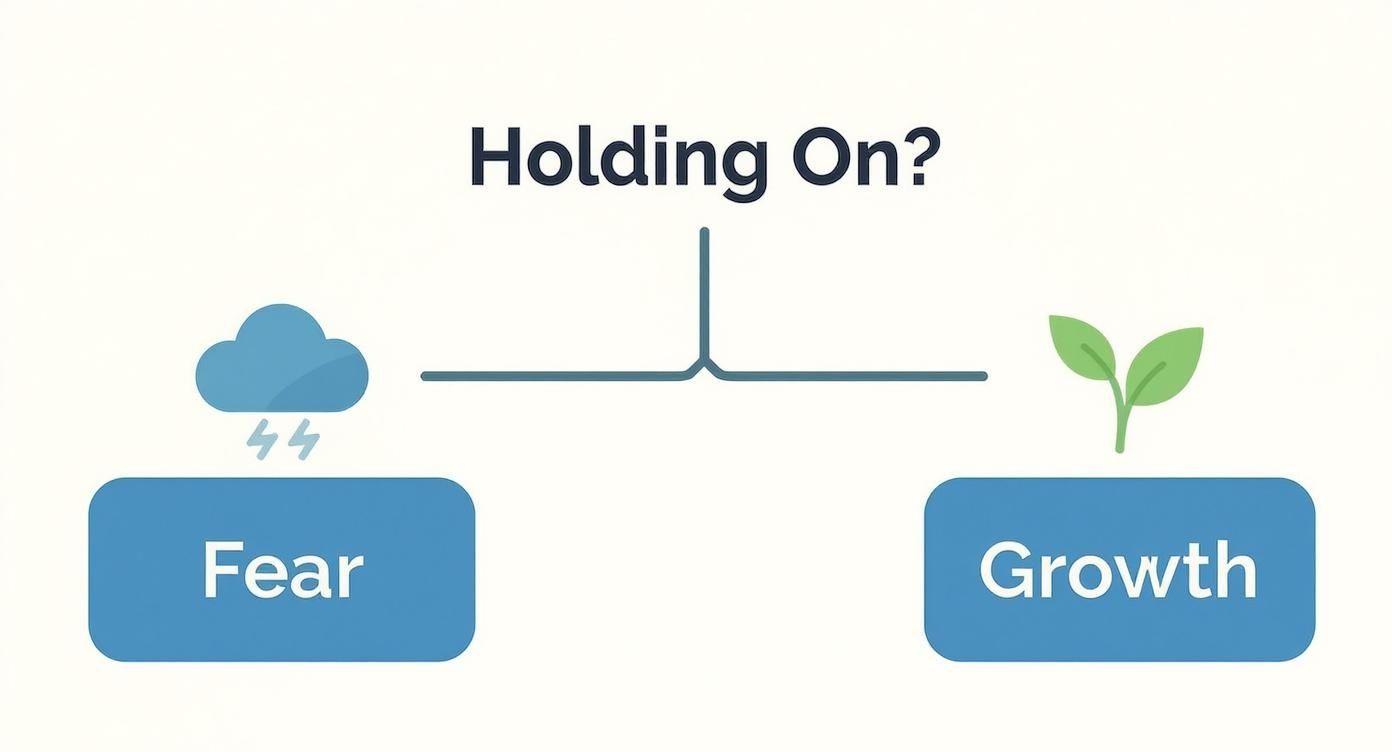
This decision tree powerfully illustrates that holding on is often rooted in fear of the unknown. The path of letting go, while uncertain, is where all the growth happens.
Journal to Process, Not to Repeat
Journaling can be an incredible tool for healing, but only if you use it the right way. Mindlessly venting on the page can often just reinforce the rumination loop you’re trying to escape. The trick is to use prompts that guide you toward insight and release, not just repetition.
The goal of journaling for healing isn’t to document the pain; it’s to understand it. Ask 'why' and 'what' questions to transform your raw experience into wisdom.
Try these prompts to shift your journaling from just repeating the story to actually reflecting on it:
- What is the primary emotion I'm feeling about this? Is it anger? Sadness? Fear? Be specific.
- What is the story I am telling myself about this situation? For example: "I will never find another partner." Is every single part of that story 100% true?
- What is one small thing this experience has taught me about my own resilience? For instance, "I learned that I'm capable of managing my finances on my own."
This need to process and move on is a universal human experience, especially clear in major life events like the end of a long-term relationship. The global trend of divorce rates, for instance, offers a wide-lens view into how entire societies navigate letting go. While overall rates in the U.S. have actually declined since their peak in the 1980s, the rise of 'gray divorce' among those over 50 shows that moving on is a skill we need throughout our entire lives.
It’s a powerful reminder that even attachments that have lasted for decades can come to an end, requiring us to adapt emotionally at any age. You can find more fascinating insights about global divorce trends on divorce.com.
Redefining Who You Are Now
A huge part of moving on and letting go is releasing an old identity. It’s a strange feeling, isn't it? When a big chapter of your life closes—a relationship ends, you leave a career, your kids grow up—it can feel like a piece of you is just… gone.
You weren't just in a partnership; you were a 'partner.' You didn't just have a job; you were a 'manager' or an 'artist.' When that label disappears, it can leave a gaping hole.
https://www.youtube.com/embed/D6YsUyvTnEw
The secret is to see this void not as an emptiness, but as an open space. It’s an opportunity to reconnect with the parts of yourself that got pushed to the background and to consciously build a new, more expansive identity.
This isn’t about pretending the past didn’t happen. It's about making sure your sense of self isn't tied to something—or someone—outside of you. Your value is inherent. It was there before, and it’s there now.
Create Your New Identity Map
Let’s be real: you are so much more than just one thing. You're a collection of passions, skills, curiosities, and values that have been simmering for years. An 'identity map' is a simple but really effective exercise to help you see all the different facets of who you are, separate from what you've lost.
It’s about remembering who you were before this chapter and starting to dream about the person you want to become next. This isn't just daydreaming; it's an active process of self-rediscovery.
Let these prompts be your starting point for mapping out your identity. Grab a pen and paper and actually write them down:
- Forgotten Passions: What are three things that used to light you up before this last chapter took over? Think back. Maybe it was hiking, learning guitar, or spending weekends lost in photography.
- Dormant Skills: What are two skills you have that have been collecting dust? Maybe you speak another language, know a bit of code, or used to love painting.
- Core Values: What are your top three non-negotiables? Things like creativity, compassion, or independence.
This little exercise helps you see that while one part of your identity has shifted, so many other parts have been there all along, just waiting for you to pay attention to them again.
From Adjectives to Action
Okay, now let's get practical about the future you. Instead of focusing on what you want to have, shift your focus to who you want to be. This small change moves you from chasing external things to cultivating internal states of being—something you have far more control over.
The most powerful step in redefining yourself is moving from "I have lost" to "I am becoming." This small linguistic shift reclaims your power and puts you back in the driver's seat of your own life.
Think about the person you want to become and describe them using only adjectives. Are you aiming to be more resilient? Curious? Adventurous? Peaceful? Pick three to five that really speak to where you are right now.
Got your words? Great. Now, for each one, brainstorm one small, tangible action you can take this week to embody it.
| If you want to be… | A small action could be… |
|---|---|
| Adventurous | Try a new restaurant in a different neighborhood by yourself. |
| Creative | Spend 30 minutes doodling with no specific goal in mind. |
| Connected | Call a friend you haven't talked to in over a month, just to say hi. |
These tiny actions start to build evidence for your new identity. They prove to yourself, one step at a time, that you are becoming the person you envision. This proactive approach is the foundation for building a life guided by your own compass. As you get clearer on this vision, you might find it helpful to learn how to create a personal mission statement to keep you pointed in the right direction.
Creating Physical and Mental Space to Heal
Healing is an inside job, but let's be honest—your external world plays a huge role. When your environment is cluttered with constant, painful reminders of the past, it’s like trying to start a new chapter with the old one still open right on your desk.
Creating both physical and mental space is one of the most powerful, tangible things you can do when you’re learning how to move on and let go.

This isn’t about pretending your history didn't happen. It's about curating it. By consciously choosing what you see and interact with every day, you’re sending a clear signal to your brain that it’s time for a fresh start. Each small change you make, whether in your home or on your phone, reinforces that decision to move forward.
Curate Your Physical Environment
Take a slow look around you. Right now. Are you surrounded by things that bring you peace and inspiration, or are you surrounded by ghosts—items that keep you anchored to a painful memory? A physical decluttering can kickstart a profound mental clearing.
One of the best ways to handle this is by creating a 'memory box'. This isn't about tossing everything out in a fit of rage or sadness. It's about giving meaningful items an honored place that isn’t in your immediate line of sight.
- Select a special box. Find one that feels fitting for the memories it will hold.
- Choose with intention. Place items inside that are part of your story but no longer serve your present well-being. Think old photos, letters, or keepsakes from a past relationship or job that you're not ready to part with but don't need to see every day.
- Store it with respect. Put the box somewhere safe but out of the way, like the top shelf of a closet or in a storage space. You're not erasing the memories; you're simply moving them out of your daily living area.
The act of physically moving objects from your daily space to a designated memory box is a powerful ritual. It tells your subconscious mind, "I honor this past, but I am no longer living in it."
Clear Your Digital Landscape
These days, our digital spaces can hold just as many emotional landmines as our physical ones. Mindfully curating your social media isn't frivolous; it's an act of self-preservation. You don’t have to delete all your accounts, but you absolutely can and should adjust what you consume.
- Use the 'Mute' feature liberally. It’s a gift. Muting accounts lets you create distance without the finality or potential drama of unfollowing or unfriending. For example, if seeing an ex-partner's vacation photos is painful, muting their account on Instagram means you won't see their posts, but you remain "friends," avoiding awkward questions.
- Unfollow accounts that drain you. If certain profiles consistently make you feel sad, angry, or less-than, it’s time to hit unfollow. Your peace is more important.
- Create new playlists. Music is wired directly to memory. Building a few new playlists that aren't tied to your past can create a fresh soundtrack for this new chapter of your life. For instance, create a "Morning Motivation" playlist with upbeat songs you've never heard before.
These personal shifts are a microcosm of larger societal trends. We see this with evolving patterns of marriage and divorce, for example. From 1970 into the 21st century, many countries saw divorce rates more than double, reflecting huge changes in how people approach commitment and, ultimately, the necessity of moving on.
You can learn more about these fascinating global trends on the OECD website. It’s a good reminder that letting go and starting over is a fundamental part of the human experience. As you clear out your personal space, you might find you have a clearer sense of what you truly want next. Taking a quiz to find your life purpose can be a wonderful next step in that journey of discovery.
Building Your New Future with Intention
Alright, we’ve done a lot of the hard internal work. Now comes the best part—turning your focus away from what was and pointing it squarely toward what’s next. This is where you start building that positive momentum again.
But here’s the key: we’re not talking about making some huge, overwhelming five-year plan. It’s about small, intentional actions that stack up, creating a quiet sense of accomplishment and flooding your life with fresh, new memories.
This phase is all about consciously building a future that actually excites you. You're shifting from a reactive state—healing from what happened—to a proactive one where you're the architect of your own comeback.

Set Goals That Are Just for You
One of the most powerful things you can do right now is set a few small, meaningful goals that have absolutely nothing to do with what you’ve left behind. The point isn’t some massive achievement; it's to generate new feelings of competence, joy, and independence. Think of them as anchors for this new chapter.
For instance, if you’re moving on from a job loss, your instinct might be to set a goal like "get a new job." But that’s still tethered to the old story. Instead, pick something completely unrelated that builds your confidence from a different angle.
- Learn to cook one complex, impressive recipe. This gives you a new skill and a tangible (and delicious) result.
- Complete a local hiking trail you’ve always wanted to try. This reconnects you with nature and proves you can navigate new territory all on your own.
- Finally finish that book on your nightstand. It provides a clean sense of completion and a much-needed mental escape.
These little wins do something amazing in your brain. They literally create new neural pathways, proving that life is full of fresh experiences and that you are more than capable of creating your own happiness.
Focus on How You Want to Feel
Instead of getting fixated on rigid outcomes, let's try a softer, more compassionate approach: intention setting. An intention is less about what you’ll achieve and much more about how you want to feel along the way. This simple shift moves the goalposts from external validation to internal fulfillment.
An intention is a guiding principle for your energy. While a goal is a destination, an intention is the way you choose to travel. It puts you in control of your inner state, regardless of the outcome.
This is incredibly freeing because it isn’t dependent on anyone or anything else. For example, your goal might be to meet new people, but you can’t control who you meet or if you click. Your intention, however, could be to "feel open and curious in social settings." See the difference? You have 100% control over that.
Here’s how to put it into practice:
- Start your day with an intention. Before checking your phone, take one minute to decide on your intention. It can be a single word or a short phrase. "Today, my intention is to be patient with myself."
- Use it as a compass. When you hit a rough patch, like getting stuck in traffic, check in with your intention. "Is honking my horn aligned with my desire to feel peaceful?"
- Reflect without judgment. At the end of the day, just notice when you felt aligned with your intention and when you didn’t. No criticism allowed.
This practice helps you build a future based on your core values, not on a checklist of accomplishments. As you step into this new life, exploring some real-world life purpose examples can offer inspiration for what a future aligned with your true self could look like.
This intentional approach to building a new life is a reflection of a broader human need to adapt and start over, a pattern seen throughout history. For instance, statistical analyses from the United Kingdom show that by the mid-1990s, about 11% of marriages ended before the fifth anniversary, a sharp increase from previous decades. This illustrates that letting go and building new futures is a fundamental aspect of the human journey.
Common Questions About Letting Go
The path to moving on and letting go isn't always a straight line. It’s full of weird detours, unexpected potholes, and moments of doubt. As you walk this road, it’s completely normal for questions to pop up.
Think of this section as a conversation about the tricky parts. These aren't rulebooks, but rather insights from the field to help you navigate your own unique healing process.
How Long Does It Really Take to Move On?
This is the big one, isn't it? The question everyone has. But the most honest answer is also the most frustrating: there's no set timeline. How long it takes depends entirely on you, the depth of the connection, the circumstances of the ending, and the support you have around you.
A much healthier way to look at it is to shift your focus from the finish line to your forward momentum.
Are you having more good days than bad? Does the past take up just a tiny bit less space in your head this week than it did last week? For example, did you go an entire afternoon without thinking about it? These are the real victories.
Healing isn't linear. It's a messy, beautiful dance of progress and setbacks. The point isn't to erase what happened, but to get to a place where the memories no longer have the power to hijack your emotions or dictate your future.
Celebrate the small wins. Every single time you redirect a painful thought or choose a new, healthier response, you are actively healing. Be patient with yourself, especially on the days that feel like a step backward.
Can I Let Go if I Still Have to See Them?
Having to interact with someone you’re trying to move on from—a co-worker, an ex you share kids with—is tough. Really tough. But it is absolutely possible to let go. The secret is to build rock-solid emotional and practical boundaries.
Your focus has to shift from creating physical distance to creating emotional detachment.
You're not letting go of the person's physical presence; you're letting go of the role they used to play in your emotional life and the expectations that went with it.
- Keep it logistical. If you're co-parenting, the conversation is about the kids' schedules and needs. Period. An actionable example: use a co-parenting app for all communication to avoid personal texts. At work, keep it professional and focused on the task at hand. No personal detours.
- Use the mute button. You don't always need the drama of a public un-friending. Protect your peace by quietly muting their posts and stories on social media. What you don't see can't hurt you.
- Lean on your support system. Have your people on speed dial. Before you have to interact, send a quick text to a friend: "Have to see my ex in 10 minutes at drop-off. Need some good vibes!" This reminds you that you're not alone.
What if I Feel Guilty About Moving On?
Guilt is a sneaky and surprisingly common part of this process. It often comes from a misplaced sense of loyalty, or a subconscious idea that staying sad is somehow honoring what you lost. The first step is just to see the guilt for what it is, without letting it drive the car.
Your happiness, your growth, and your peace are not a betrayal of the past. In fact, choosing to heal and move forward is a profound act of self-respect. It's a testament to your own resilience.
Here’s a practical exercise: write a letter to the person or situation. You don't ever have to send it. In that letter, give yourself explicit permission to be happy again, to find joy, to build a new life. Putting those words on paper can feel like turning a key, unlocking a door you didn't even realize was closed. For example, you might write, "To my old career, I'm grateful for what you taught me. I am now giving myself permission to find fulfillment in a new field without feeling like I'm betraying the time I invested in you."
At How To Find Your Life Purpose, we create tools and guides to help you navigate these exact kinds of challenges. If you feel ready to build a future that's truly aligned with who you are, a great place to start is by exploring our resources at the Find Your Life Purpose website.